
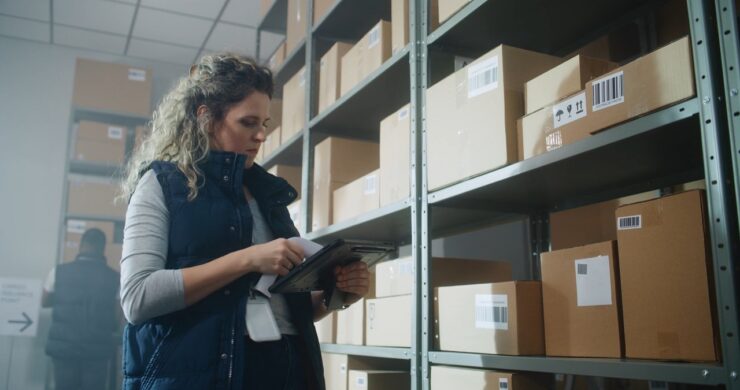
For most Amazon sellers past the early hobby stage, a professional prep center is cheaper per unit, faster at scale, and operationally safer than in-house prep. In-house prep only makes financial sense when volume is low, SKUs are limited, and labor is truly free.
Once palletized shipping, sales tax exposure, and FTL timing enter the picture, prep centers usually win on total cost and reliability.
What “prep” actually means in daily operations

Prep is not just slapping labels on boxes. In practice, it includes inbound receiving, quantity verification, damage checks, labeling to Amazon standards, poly-bagging, bundling, carton optimization, pallet building, appointment scheduling, and shipment creation inside Seller Central. When done in-house, all of this sits on your time, your space, and your liability.
That matters because the cost is rarely visible at first. Sellers usually compare only the per-unit prep fee and forget the hidden layers.
Cost comparison: real expenses sellers overlook
In-house prep feels cheaper because it hides costs inside your personal time and existing space. Prep centers charge transparently, so the bill feels heavier even when it is not.
In-House Prep: where money leaks quietly
When sellers calculate in-house prep costs honestly, this is what usually shows up:
| Cost Category | Typical Reality |
| Labor | Your time or paid help at peak rates |
| Space | Garage, spare room, or rented storage |
| Supplies | Labels, tape, poly bags, boxes, pallets |
| Errors | Relabeling, refusals, stranded inventory |
| Opportunity cost | Less time for sourcing and pricing |
If you value your time at zero, in-house prep can work. The moment you value it at even a modest hourly rate, the math shifts fast.
Prep Center: visible but predictable costs

Prep centers charge per unit or per task, which feels expensive until you compare line by line.
| Cost Category | What You Actually Pay |
| Prep labor | Flat per-unit or per-task rate |
| Storage | Short-term, usage-based |
| Materials | Included or billed at cost |
| Error reduction | Standardized processes |
| Scale efficiency | Lower cost per unit at volume |
At scale, prep centers compress cost variability. In-house prep expands it.
Speed: why volume changes everything

Speed is not about how fast you can label one box. It is about how fast 500 units become check-in ready.
In-house prep works fine at small volumes. Once shipments grow, bottlenecks appear. Label printing queues. Box shortages. Missed carrier pickups. Delayed Amazon appointments.
Prep centers operate in parallel. Multiple staff. Dedicated dock doors. Daily pickups. That difference becomes critical during Q4, deal windows, or restock emergencies.
Turnaround time comparison
| Scenario | In-House Prep | Prep Center |
| 50 units | Same day | Same day |
| 300 units | 1–2 days | Same or next day |
| 1 pallet | 2–4 days | 24–48 hours |
| 5 pallets | 1+ week | Scheduled same week |
Speed compounds into sell-through velocity. That directly affects rank and cash flow.
Tax exposure: the silent deal breaker
Sales tax nexus is one of the most misunderstood risks in in-house prep.
When inventory is stored or processed in your state, you often create tax nexus. That can trigger registration, filings, and audits you never planned for. Many sellers realize this only after revenue grows.
Prep centers located in tax-friendly states can significantly reduce this exposure by keeping inventory outside your home state footprint.
This is where Delaware, New Hampshire, and similar locations matter. Not as a loophole, but as a structural advantage.
Midway through scaling, many sellers shift specifically for this reason. One example is Dollan Prep Center, which operates in a sales-tax-friendly state and is structured around high-volume Amazon workflows. At that point, the decision stops being about labels and starts being about compliance and long-term risk.
FTL shipping: where prep centers pull ahead hard
Full Truckload shipping changes the equation completely.
FTL only makes sense when pallets are built correctly, scheduled efficiently, and shipped from locations with strong carrier access. This is where in-house prep usually breaks.
In-House FTL challenges
| Issue | Why It Hurts |
| No dock | Liftgate fees add up |
| Poor palletization | Carrier refusals |
| Missed appointments | Storage penalties |
| Rate shopping | Time-intensive |
Prep Center FTL advantages
| Advantage | Practical Impact |
| Commercial docks | Lower freight rates |
| Standard pallets | Amazon compliant |
| Carrier networks | Faster booking |
| Consolidation | Cheaper per unit |
Prep centers can combine multiple inbound shipments into a single optimized FTL load. That alone can erase months of prep fees in freight savings.
Control vs consistency: the psychological barrier
Many sellers resist prep centers because they want control. They trust their own hands more than a third party.
That instinct makes sense early on. Over time, consistency beats control.
Prep centers operate on checklists, SOPs, and Amazon compliance standards. In-house prep operates on memory and availability. Errors happen more often than sellers admit.
Missed labels. Wrong suffocation warnings. Mixed SKUs. One mistake can stall hundreds of units.
When in-house prep still makes sense

There are cases where in-house prep is the right call:
| Situation | Why It Works |
| Very low volume | Fixed costs dominate |
| Private handmade items | Custom handling |
| Local retail arbitrage | Immediate turnaround |
| Testing new products | Flexibility matters |
The key is recognizing when you have outgrown it. Most sellers wait too long.
Decision framework: how to choose without guessing
Ask these questions honestly:
| Question | If Answer Is “Yes” |
| Do you ship pallets monthly? | Prep center favored |
| Do you value your time? | Prep center favored |
| Do you want to reduce tax exposure? | Prep center favored |
| Do you rely on FTL shipping? | Prep center favored |
| Are volumes inconsistent? | In-house may still work |
This is not about loyalty to one model. It is about operational maturity.
Bottom line
In-house prep feels cheaper because the bill is invisible. Prep centers feel expensive because the bill is clear. Once volume, freight, and tax exposure enter the picture, prep centers usually reduce total cost and increase speed at the same time.