

Privacy used to be the default state of the world. Ambient, free, and unnoticed – like clean air, nobody thought to price it.
Today it is a product with a price tag, and not in a hand-wavy, metaphorical sense. You can pay a monthly subscription to stop one newspaper from tracking you.
You can pay six figures a year to have your name scrubbed from data broker lists.
You can pay five figures a night for a villa positioned so that no other human being appears on the horizon.
Somewhere along the way, being left alone stopped being a right and became an amenity.

The strange part is not that privacy got expensive. The strange part is the logic of the market that grew up around it.
Discretion is the one luxury good in the whole economy you can never display – the only status marker that vanishes the moment you try to show it off.
And like every other luxury, it tends to be bought by the people who need it least, while the people who need it most cannot afford the price of admission.
A wall with a price tag
Travel through Europe’s digital economy and you keep hitting the same wall under different names: consent or pay, pay or okay, pay-or-tracking wall.
Read the site for free and agree to be tracked for advertising, or pay a subscription to read it without the tracking.
Meta rolled out the same choice across Facebook and Instagram in the European Union in November 2023, at €9.99 to €12.99 a month for the tracking-free version.
Here is the number that should stop you. Research into top publishers in Austria, France, Germany and Italy found that pay-or-okay systems produce consent rates of around 99.9 percent – what privacy advocacy group noyb, in its 2025 report on the practice, bluntly calls a “North Korean consent rate” – while the studies it cites put the share of people who actually want personalised advertising somewhere between 0.16 and 7 percent.
Why would an industry love a model that almost nobody pays for? Because the pay option is priced to be refused. noyb’s analysis of the underlying academic research found that publishers earn, on average, €0.24 per user per month from tracking people – and €3.24 per user per month from the small minority who buy privacy instead.
The wall more than pays for itself even at a 99 percent consent rate; the researchers who modelled the economics estimated it lifts publisher revenue by 16.4 percent compared with a plain cookie banner.
The pay-or-tracking wall, in other words, is less a shopfront for privacy and more a consent-optimisation machine.
Let me give the other side its due, because there is a real argument here. Someone has to fund journalism, the reasoning goes, and if your data is the price of the “free” product, then offering a money-based alternative gives readers a genuine choice that a cookie banner never did.
Several national data protection authorities – the Austrian, Danish, French and German ones – have accepted the model, provided the pay price stays reasonable.
Felix Mikolasch, a data protection lawyer at noyb, counters that “Pay or Okay has spread throughout the EU in recent years and can now be found on hundreds of websites,” while regulators have still not agreed on a consistent position. I think the authorities have been too kind.
A genuine choice does not produce 99.9 percent consent. That rate is the tell: the wall exists to expand tracking, and the escape hatch is priced precisely so that only people with disposable income – and the conviction that they have something to hide – will take it.
The digital castle
Nobody documents the privacy class divide more cleanly than the market itself. At the bottom sit the automated services: DeleteMe, Incogni, Google’s free personal-information-removal tool – the do-it-yourself tier where a bot files removal requests on your behalf.
At the top sit firms like BlackCloak and 360 Privacy, which deploy humans to systematically erase executives’ and celebrities’ personal information from search engines, data brokers and the dark web.
The figures from an Observer investigation published this year are the sharpest illustration of the divide I have come across. BlackCloak’s services for high-net-worth individuals and family offices run from roughly $10,000 to $200,000 a year, with enterprise contracts for C-suite executives and board members reaching $600,000.
All of that money chases a data-broker industry worth about $40 billion a year in North America – a market that exists specifically to collect and resell personal information, and that therefore makes the erasure industry necessary.
It is a perfect feedback loop: the more the brokers hoard, the more the wealthy pay to be removed, the more the data that remains is worth.
Why do the rich need the white-glove tier at all? Because erasure is a war of attrition. Data brokers insert CAPTCHAs and rotation to defeat the bots that cheaper services rely on, and the median value of security protections for executives at S&P 500 companies jumped 37.8 percent between 2024 and 2025 as firms moved to shield people whose personal accounts are under fire.
A 2025 report from BlackCloak and the Ponemon Institute found that 51 percent of security leaders now report cyberattacks aimed at executives’ personal accounts and those of their families. The wealthy are not buying removal; they are buying ongoing defence.
But here is the detail that should make you uncomfortable: the erasure never fully works. Newspaper archives, court records, campaign donation lists – the public record stays public, even for someone paying $200,000 a year.
Even at the very top of the market you are buying discretion, not invisibility. Which is a useful reality check on the fantasy that money can purchase a clean slate.
| Tier | What you buy | Price | Source |
|---|---|---|---|
| Consent to tracking | Nothing – you are the product | Free | – |
| Pay-or-okay subscription | Not being tracked on a single site | €3.24 per user/month average pay option | noyb, July 2025 |
| Budget data-removal app | Automated removals plus dark-web monitoring | from $32/month | Observer, August 2026 |
| Elite data-removal firm | Human-driven erasure for high-net-worth clients | $10,000–$200,000/year | Observer, August 2026 |
| Corporate-grade privacy | The same service for C-suites and boards | up to $600,000/year | Observer, August 2026 |
| Secluded resort villa | Physical unreachability | from about $3,300/night | AFAR, October 2024 |
Figures as reported in the named sources, all checked in August 2026. The €3.24 figure reflects the average pay-option price in the academic research summarised in noyb’s July 2025 report.
Seclusion, now with room service
The same logic that prices privacy in the data economy has colonised the physical world – and the physical world is where the pricing gets theatrical.
Luxury travel has quietly become a product about not being seen. Industry data cited by Robb Report this year found that 86 percent of luxury travellers now prioritise privacy and seclusion, and 83 percent pay for exclusive access: a polite way of saying they pay to keep other people out.
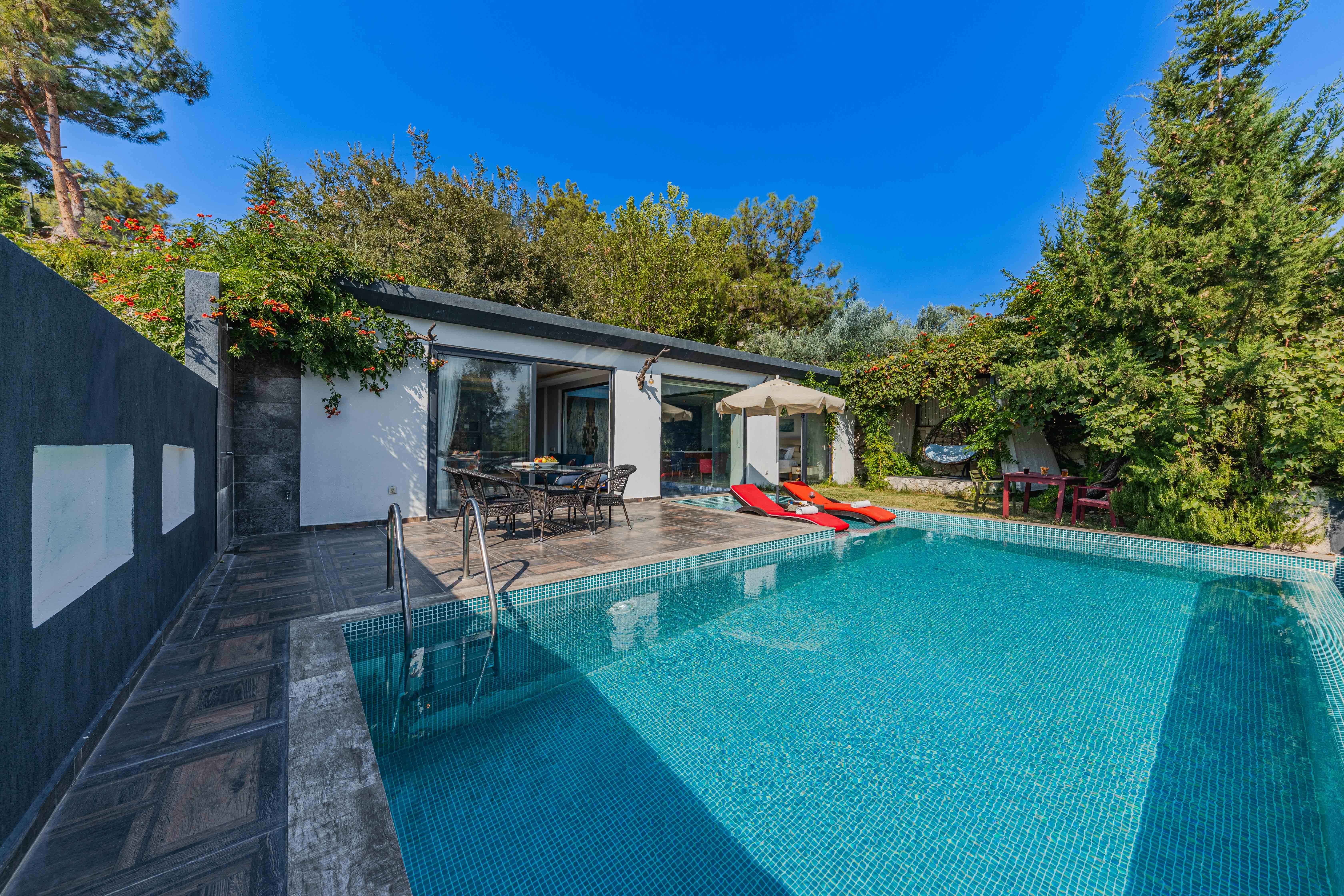
The result is a hospitality arms race measured in degrees of concealment. Soneva Secret in the Maldives – 14 villas, not another island visible on the horizon – starts around $3,300 a night, and its entire premise is that you need never leave your villa.
At the Hotel Bel-Air in Los Angeles, staff tell the story of the three surviving Beatles staying at the hotel simultaneously without any of them knowing the others were there; the hotel’s own press material calls its approach “protective culture for the world’s most powerful players.”
Alias check-ins, valets doubling as gatekeepers, guest folios encrypted and quietly erased on request – the modern five-star hotel has effectively become a data-privacy company with a pool attached.

And the market for discretion reaches well beyond hotel gates. Private dining rooms are booked in a way that no photograph ever leaves the room.
Members’ clubs vet you harder than they charge you. In Munich, a city where a certain restraint has long been part of the local etiquette, the same logic runs through the service economy: from private chefs to a München escort, the guarantee is identical – what happens here stays here.
Discretion has stopped being a courtesy and become the product itself, priced simply as the cost of being believed.
A luxury good you can’t show off
And here is where the economics turn genuinely strange.

Every other luxury good exists to be seen. A hand-finished watch, a waterfront villa, a vintage perfume – part of the value lives in the signalling, in other people knowing you can afford it. Discretion is the only luxury that dies the moment you display it. You cannot post your anonymity on Instagram.
The concierge who knows your name is contractually required to forget it. Wealth buys seclusion precisely so that nobody learns the wealth was spent.
This inverts the whole status hierarchy. Visible luxury is for the aspirational – the people who want to be seen as rich. Discretion is for the people who already are, or whose visibility is a liability: celebrities, executives, anyone whose public footprint can be weaponised.
Which is why privacy-as-a-luxury is stranger than it looks. What makes it a luxury is not scarcity. It is the fact that wanting it advertises that you have something to hide – which is exactly why so many people, even when they can afford it, decline to buy. Paying €4 a month to stop one publisher tracking you feels like a confession.
Clicking “accept all” feels like nothing at all.
The research keeps confirming the paradox. A 2019 survey of 2,416 Americans found a median willingness to pay of just $5 for privacy protection, regardless of what type of data was at stake.
People rank privacy as important and then refuse to spend pocket change on it – not only because it is overpriced, but because buying it is a small admission that you need it.
Which is how most of us end up buying the perfume rather than the privacy.

The middle market – VPNs, ad blockers, private browsers, encrypted email – sells the scent of discretion: the pleasant feeling of being unseen, at the price of a coffee subscription.
And like all fragrances, it fades. A VPN hides you from the coffee shop’s Wi-Fi; it does nothing about the data broker holding your address, your income band and your social graph.
The wealthy do not buy the perfume. They buy the erasure, the seclusion, the legal team, the private island.
Everyone else buys a small subscription that flatters our sense of protection while the tracking continues quietly underneath.
Who ends up paying
Academics named this pattern before the walls arrived. In a 2017 article in the Columbia Law Review, law professor Stacy-Ann Elvy described a “privacy-as-a-luxury model” in which companies sell stronger privacy protection at a higher price – transforming privacy into a tradable product affordable, in her words, by “a select few.”
Her warning was that pay-for-privacy models would widen unequal access to privacy. Nearly a decade later, the evidence suggests she was right.
Because consider who actually lives under the surveillance economy. The person on a discount phone whose cheapness is subsidised by data collection.
The gig worker who must share location in order to earn. The reader who cannot spare a few euros a month and clicks “accept all” like everyone else.
Their data becomes the training data, the credit model, the insurance score – and the people whose data is most valuable are the least able to opt out and the least likely to benefit from the decisions made with it.
The comparison to Victorian Manchester keeps getting drawn for a reason: the wealthy built upwind of the factories, and the poor breathed the smoke.
The fix is the one economists prescribe for any externality: regulation. Privacy-as-a-default rather than privacy-as-a-priced-option – tracking off unless you actively switch it on, opting out free and frictionless. The irony is structural.
The people most harmed by surveillance are the least represented in the rulemaking about it, and the lobbyists for the data economy are better funded than the advocates for the tracked.
So here is where I land. The strange economics of discretion is not that privacy became expensive – everything scarce eventually gets a price. It is that the price was set deliberately, and set so that the affluent can buy their way out while the rest of us, even those with a few euros to spare, are nudged into accepting that being watched is simply the cost of being online.
Privacy-as-a-luxury was a choice, not a law of nature. It was made by a market and a regulatory system working together. It can be unmade the same way.